Choosing a Hybrid Power Inverter in 2026 starts with your actual energy needs, not the largest number on a product page. This unit connects solar panels, a battery, the utility grid, and household circuits, so its limits affect daily comfort and backup performance. Start with your loads. A refrigerator, router, and a few lights need far less power than an electric range or well pump.
Check continuous output and surge capacity against the appliances you expect to run together. Then confirm the inverter’s battery voltage, chemistry compatibility, solar input range, and charging current match your planned system. Small mismatches can cause reduced output, limited charging, or avoidable equipment changes. Details matter. Compare operating efficiency, transfer behavior during outages, cooling requirements, display or app features, and warranty terms. A quiet garage installation may suit a different model than a hot, dusty utility room.
The best Hybrid Power Inverter is not automatically the one with the most features. It is the one whose specifications fit your panels, battery, electrical loads, and future expansion plans. Product labels can be confusing, and published ratings may use different test conditions. Read the technical datasheet, ask the manufacturer about unclear limits, and have a qualified installer verify system compatibility. That extra check may feel tedious. It can also prevent an expensive surprise. This guide explains the key choices, common trade-offs, and practical questions to ask before buying in 2026.
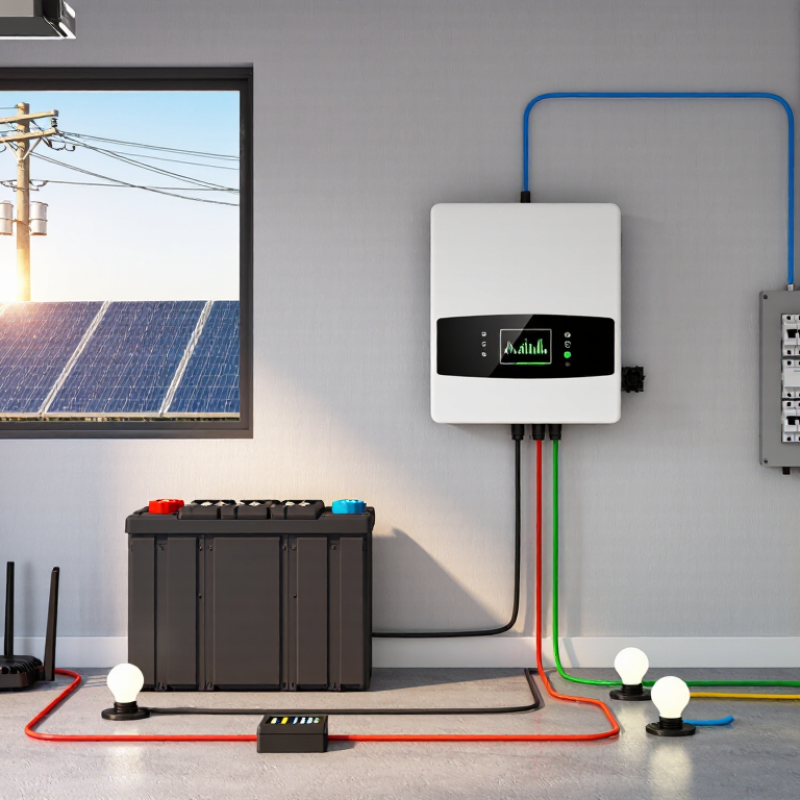
A hybrid power inverter connects solar panels, a battery, household circuits, and sometimes the utility grid. Solar panels produce direct current (DC); most home appliances use alternating current (AC). The inverter converts DC into usable AC and manages where power flows. When sunlight exceeds demand, it can send surplus energy to the battery. Later, the battery can supply power when panels produce less. Simple in principle. The switching logic matters.
The IEA PVPS Snapshot of Global PV Markets 2024 estimated 407–446 GW of solar capacity was installed worldwide in 2023. More solar means more homes may need to coordinate generation and storage.
Still, a hybrid inverter does not guarantee backup power during an outage. It needs suitable islanding controls and a correctly configured backup circuit; otherwise, safety protections may shut it down.
NREL’s 2024 Annual Technology Baseline uses about 85% round-trip efficiency for utility-scale batteries. That is a useful benchmark, not a promise for a residential system. Conversion losses, battery settings, and household load all affect actual performance.
A kettle starting while lights and heating are running can expose limits that a tidy specification sheet may not show. Check continuous output, surge capacity, battery compatibility, and backup-circuit design for the specific installation.
Choosing a hybrid power inverter starts with a realistic list of what must keep running. Write down each device, its wattage, and the hours you expect to use it during an outage. A refrigerator may draw modest power while running, then briefly need much more when its compressor starts. Check both running and surge ratings. Keep it practical.
Next, separate essential loads from convenient ones. A router, a few lights, and a medical device may matter more than an oven or clothes dryer. Add their estimated energy use in watt-hours: a 100-watt device used for five hours needs about 500 watt-hours. Battery sizing should allow for conversion losses and some reserve, not just match the arithmetic exactly. That margin is easy to overlook.
Also consider how the battery will recharge and how long an outage could last. Solar panels, grid charging, and a generator each have different limits, so confirm the inverter supports the charging setup you actually plan to use. Compare continuous output, surge capacity, battery voltage, and usable battery capacity. A larger inverter is not automatically better; it can add cost and may perform poorly with a mismatched battery. I would revisit the load list after a week of ordinary use. Estimates look neat on paper, but real habits are less tidy.
| Planning Area | What to Define | Selection Rule or Calculation | Illustrative Example | What to Verify |
|---|---|---|---|---|
| Essential backup loads | List the appliances and circuits that must remain powered during an outage. Record each load’s running watts and expected hours of use. | Daily backup energy (kWh) = sum of each load’s watts × operating hours ÷ 1,000. | A 100 W router used for 8 hours consumes about 0.8 kWh. Add the energy use of every other backed-up load. | Use appliance labels or measured consumption where possible. Loads such as pumps and compressors may draw more power at startup than while running. |
| Continuous inverter output | Estimate the highest total power of the loads that may run at the same time. | Choose continuous AC output above the maximum simultaneous running load, with reasonable headroom for operating conditions. | If loads expected to run together total 3,000 W, select an inverter whose continuous output exceeds 3,000 W. | Check the output rating at the applicable temperature and installation conditions. Do not treat a short-term peak rating as continuous capacity. |
| Surge and motor loads | Identify the startup requirements of refrigerators, well pumps, air conditioners, and other motor-driven equipment. | Confirm that both the inverter’s surge power and surge duration can support the load’s starting requirement. | A motor that runs at 800 W may briefly require substantially more power to start; use the motor or appliance manufacturer’s startup data. | Check surge limits, duration, and whether multiple motors could start at the same time. A high surge-watt figure alone does not specify how long it is available. |
| Backup duration and battery capacity | Set the desired backup hours or days and determine the energy the backed-up loads will use during that period. | Approximate nominal battery capacity (kWh) = required AC energy ÷ (usable depth of discharge × inverter efficiency). | For a 1.2 kW load running 4 hours, with 80% usable depth of discharge and 92% inverter efficiency: 4.8 ÷ (0.80 × 0.92) ≈ 6.5 kWh nominal battery capacity. | Use the battery’s permitted depth of discharge and the inverter’s efficiency at the expected load. Allow for aging, temperature, and any reserve capacity. |
| Battery power and DC current | Check that the battery can supply the inverter’s required power, not just store enough energy. | Approximate DC current (A) = AC output power (W) ÷ (battery voltage (V) × inverter efficiency). | A 5,000 W AC load on a 48 V battery at 92% efficiency requires about 113 A: 5,000 ÷ (48 × 0.92). | Confirm the battery’s continuous and peak discharge-current limits, inverter DC input limits, cable sizing, protective devices, and approved battery communication protocol. |
| Solar array size | Estimate how much energy the array should generate and whether it must recharge the battery after an outage. | Approximate PV capacity (kW) = daily energy target (kWh) ÷ (local peak sun hours × overall system efficiency). | For a 6 kWh daily target, 4 peak sun hours, and an assumed 80% overall system efficiency: 6 ÷ (4 × 0.80) ≈ 1.9 kW of PV capacity. | Peak sun hours vary by location, season, orientation, shading, and weather. Check the inverter’s PV voltage range, maximum input current, and maximum PV power. |
| Electrical service and output | Match the inverter to the home’s supply voltage, phase, frequency, and required backed-up circuits. | Choose an output configuration compatible with the site and the loads intended for backup. | A home with 120/240 V split-phase loads needs an inverter and backup arrangement specifically compatible with that service. | Verify local grid standards, neutral and grounding requirements, transfer equipment, and whether the inverter can supply all or only selected circuits. |
| Grid interaction and transfer | Decide whether the system will export energy, provide backup during outages, or operate without grid export. | Confirm that the inverter’s operating modes and transfer function match the intended system design. | A grid-connected system that must keep selected loads powered during an outage needs an appropriate backup output and isolation from the utility grid. | Grid export and interconnection may require utility approval and certified equipment. Installation must follow applicable electrical codes and be completed by a qualified professional. |
| Expansion and operating limits | Consider future battery additions, additional PV, and changes in household loads. | Check the inverter’s supported battery capacity, parallel operation limits, PV input limits, and firmware or communication requirements. | If future loads may increase, compare the planned system with the inverter’s maximum continuous output and the battery bank’s supported discharge power. | Expansion is only possible within the manufacturer’s stated compatibility and electrical limits; batteries of different types or ages may not be suitable for combining. |
How to Choose a Hybrid Power Inverter?
Match inverter capacity to the loads you expect to run at the same time, not the total wattage printed across every appliance. List each device’s running watts, then add the likely simultaneous loads. A refrigerator might use modest power once running, yet its compressor can demand a brief surge at startup. Check the inverter’s continuous rating and surge rating separately. Keep some headroom; estimates are rarely perfect.
Tips: Read appliance labels and manuals. Note starting watts for motors, pumps, and compressors. Confirm the inverter’s AC voltage and phase match your electrical system. Have a qualified electrician check wiring and protective devices before installation.
Capacity is only one part of the match. Verify that the battery voltage suits the inverter’s DC input, and that cables and battery protection can handle the expected current. A larger inverter cannot make a small battery deliver more energy. Also consider which circuits need backup: powering lights, a refrigerator, and a router is different from running an electric range or water heater. Real household use can be untidy, so review your load list after observing what actually runs together.
A hybrid inverter should match the actual loads, battery, and solar array—not just the largest number on its label. Check continuous output and surge capacity against equipment such as a refrigerator, pump, or workshop motor. Their startup demand can briefly exceed normal running power. I still find surge ratings easy to overlook.
Compare the inverter’s PV voltage and current limits with the array design, and confirm that its battery voltage and chemistry are supported. Look for overload, short-circuit, over-temperature, and over- or under-voltage protection. Ground-fault detection and safe grid-disconnection functions may also matter, depending on the system. Clear fault codes help when a display shows an error during a cold morning or heavy load.
Certifications are not interchangeable across markets. Check the exact model’s documentation for applicable safety standards, such as IEC 62109 or UL 1741, and verify that the certification covers the intended installation. A certificate alone does not prove compatibility with every battery or local grid requirement. Ask a qualified installer to review the system design and confirm the documents. That extra check may feel tedious, but inverter specifications can be surprisingly easy to misread.
Compare the enclosure’s water-ingress rating when assessing inverter protection for an outdoor installation. The bars show the water-protection digit in the IEC 60529 IP code; they are category labels, not a linear measure of protection.
How to use this: IPX ratings describe water protection only; “X” means the dust-protection digit is not specified. For IPX7 and IPX8, check the manufacturer’s stated immersion conditions. Also verify that the inverter’s safety and grid-interconnection certifications apply to your installation region.
How to Evaluate Installation, Compatibility, and Long-Term Costs
Start with the installation, not the feature list. Check where the inverter will sit: a shaded, dry wall with enough clearance for cooling and service access. Measure cable routes and note the distance to the battery and electrical panel. Long runs can add cost and losses. Measure twice. A qualified installer should verify wiring, protection devices, and backup circuits for the specific home.
Compatibility is more than matching voltage. Compare the inverter’s battery voltage range and supported chemistry with the battery’s specifications. Check solar-panel string voltage and current against the inverter’s limits, including cold-weather voltage increases. Confirm which circuits receive backup power during an outage. A system may keep lights running but not a large pump or heating unit. That detail is easy to miss.
Estimate ownership costs over several years, not just the purchase price. Include installation, monitoring, standby energy use, and possible battery replacement. Review warranty terms carefully, especially capacity retention and service coverage. Ask how local support handles faults, and whether replacement parts remain available. Efficiency ratings help, but real output also depends on temperature and system design. I would leave room in the budget for one unexpected repair; estimates rarely capture every detail.