Leave Your Message

2026 Top RV Off Grid Solar Systems for Global Buyers

For global RV travelers, solar power is becoming more practical, but “off-grid” still demands careful planning. The International Energy Agency’s Renewables 2024 report expects global renewable capacity to increase by nearly 5,500 GW by 2030, with solar PV providing most of that growth. This expansion supports wider access to panels, batteries, and power electronics. However, supply quality, certification, and after-sales service still vary between markets.

A reliable Rv Off Grid Solar System must match real daily loads, not marketing claims. A 400-watt rooftop array may run lights, phones, a compressor refrigerator, and modest laptop use in strong sunlight. It may struggle with air conditioning, induction cooking, or heating. Battery capacity matters too. A 2-kWh lithium battery can feel generous during a sunny afternoon, then become inadequate after two cloudy days. NREL’s PVWatts guidance shows why location, roof angle, shading, and weather strongly influence solar output. A panel beside a roof vent may produce less than expected.

This 2026 guide evaluates complete systems for different climates, vehicle sizes, budgets, and travel habits. It considers panel efficiency, MPPT charge control, battery safety, inverter performance, monitoring, installation support, and regional compatibility. The IEA provides a valuable global perspective, while NREL offers practical modeling principles for estimating production. Still, no report can predict every campsite or driving pattern. My first instinct was to rank systems by wattage, but that would be incomplete. Real experience suggests that dependable wiring, clear battery data, and accessible support often matter more than impressive headline capacity.

2026 Top RV Off Grid Solar Systems for Global Buyers

RV Off-Grid Solar Systems: Core Components and Operating Principles

2026 Top RV Off Grid Solar Systems for Global Buyers

RV Off-Grid Solar Systems: Core Components and Operating Principles

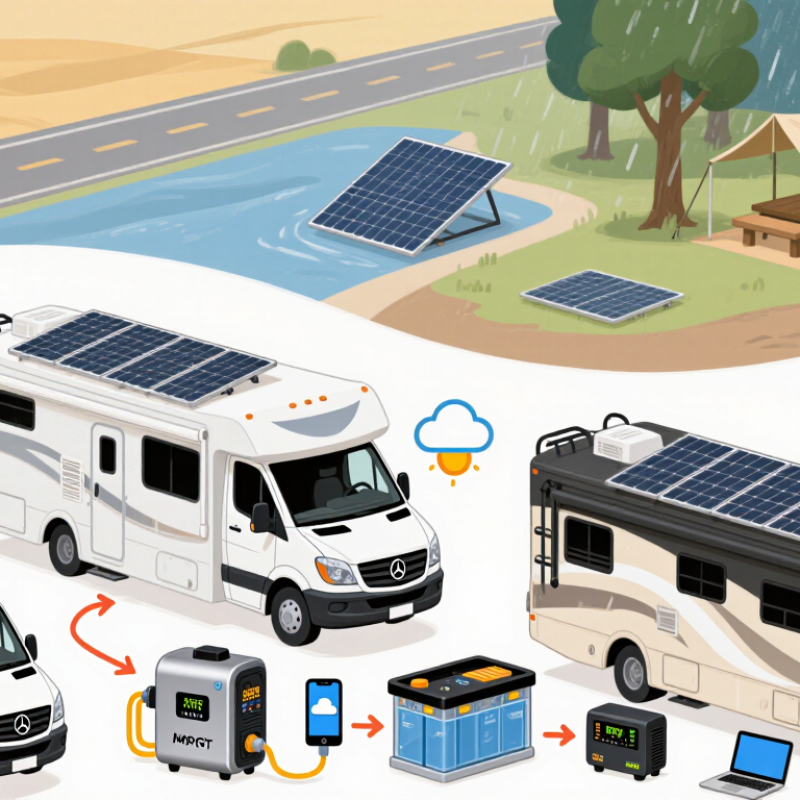
An RV off-grid solar system turns sunlight into usable electricity through several coordinated components. Solar panels produce direct current, but their output changes with shade, temperature, and panel angle. A charge controller regulates this fluctuating energy before it reaches the battery bank. MPPT controllers usually extract more power in weak sunlight, while basic controllers may suit smaller, simpler installations.

The battery stores energy for cooking, lighting, refrigeration, and communication after sunset. Lithium batteries offer strong usable capacity, but their protection system and temperature limits require careful attention. An inverter changes stored direct current into alternating current for household appliances. It should match the appliance’s starting surge, not only its running wattage. Fuses, disconnects, suitable cable sizes, and secure terminals protect the system from faults and overheating. Small details matter.

A monitoring device shows voltage, current, battery state, and daily solar yield. These readings help identify poor connections or unexpected consumption. In real travel conditions, energy planning is never perfectly clean. A cloudy campsite, dusty panels, or a portable heater can upset the calculation. Many buyers also overlook regional electrical standards and charging requirements. The best design balances local sunlight, roof space, driving habits, battery capacity, and repair access, rather than chasing the largest possible panel array.

How to Calculate RV Energy Demand and Solar Capacity

For a reliable RV off-grid solar system, measure energy demand before choosing panels. Start with a load list. Record each appliance’s wattage and daily running hours. Multiply watts by hours to obtain watt-hours, or Wh. A 60-watt refrigerator running eight hours uses about 480 Wh. A 35-watt ventilation fan running six hours adds 210 Wh. Lights, laptops, water pumps, and phone charging may add another 240 Wh. This example reaches roughly 930 Wh daily.

Allow for inverter losses, cable resistance, battery charging losses, and unexpected use. Adding 15 to 25 percent is practical, although real travel habits can change quickly. At 1,100 Wh per day, four peak-sun hours require about 344 watts of solar capacity when system efficiency is estimated at 80 percent. A 400 to 450-watt array gives more useful margin during cloudy periods, winter travel, or partial shading. More panels do not solve every problem.

Battery capacity deserves equal attention. For one day of storage, 1,100 Wh divided by 12 volts and 80 percent usable capacity requires approximately 115 amp-hours. Two cloudy days would need about 230 amp-hours. Keep continuous inverter loads separate from short startup surges. A refrigerator compressor may briefly demand much more power than its label suggests. Field measurements are better than assumptions, but even measurements can be imperfect. Check actual consumption over several trips. Expect to revise the design.

Choosing Solar Panels, Batteries, Inverters, and Charge Controllers

For a 2026 RV off-grid solar system, each component must match the vehicle’s real energy habits. The IEA’s Renewables 2024 report states that solar represented about three-quarters of new renewable capacity added in 2023. That growth improves availability, but not every panel suits mobile use. Choose high-efficiency panels when roof space is limited. Check temperature coefficients, shading performance, weight, and mounting strength. NREL research reports median photovoltaic degradation near 0.5% annually, so output slowly declines.

Battery selection deserves careful calculation. Estimate daily watt-hours from refrigeration, lights, fans, electronics, and inverter losses. Then add cloudy-day reserve. Lithium batteries usually provide more usable energy and lower weight, but cold charging can be unsafe without temperature protection. Lead-acid systems cost less initially, yet their practical usable capacity is smaller. I sometimes oversize storage and undersize solar input. That mistake creates slow recovery after several cloudy days. Use a pure-sine inverter for sensitive appliances, and select continuous and surge ratings separately. An MPPT charge controller can harvest more energy under changing panel voltage, but its current rating must exceed the array’s expected output.

Tips: Keep panel cables short and properly sized. Install fuses near battery terminals. Leave ventilation around power electronics. Test the system at midday and after sunset. Review actual consumption for one week before purchasing. Portable living is unpredictable. A perfect spreadsheet is not reality. Use regional sunlight data, local electrical rules, and qualified installation advice before final wiring.

2026 Top RV Off-Grid Solar Systems for Global Buyers

Representative RV system configurations compared by solar array size, usable battery storage, inverter output, and estimated daily energy yield.

Estimates assume approximately 4 peak-sun hours per day, 80% usable battery capacity, and typical system losses. Actual performance varies with weather, temperature, installation angle, shading, and electrical loads.

Installation Methods for Different RV Types and Travel Conditions

For 2026 RV off-grid systems, installation should match the vehicle, not only the panel wattage. The RV Industry Association reported 313,174 wholesale shipments in 2023, showing a large and varied installation market. Rigid motorhomes usually support fixed panels on reinforced roof zones. Use low-profile brackets, sealed cable glands, and a service gap beneath each panel. Keep vents and air-conditioning units clear. Roof shadows can sharply reduce daily output.

Pop-top campers and compact vans need lighter panels and flexible wiring loops near moving roof sections. Protect cables with UV-resistant conduit. Do not place connectors where the roof folds. Towable trailers often benefit from a roof array combined with a portable ground panel. This helps when the trailer is parked under trees. The International Energy Agency reported that global photovoltaic additions exceeded 400 GW in 2023, but RV installations still face smaller roofs and frequent shading. Big solar growth does not solve poor placement.

Travel conditions change the mounting method. In deserts, leave airflow below panels and check dust buildup after every long drive. In snowy regions, use stronger brackets and avoid locations where sliding snow can strike vents. Coastal travel demands corrosion-resistant fasteners and frequent inspection. The National Renewable Energy Laboratory notes that heat lowers photovoltaic performance; enclosed roof spaces can become much hotter than ambient air. A practical mistake is oversizing the array while ignoring battery capacity and cable losses. Recheck the design. Small wiring errors become expensive on remote roads.

2026 Top RV Off Grid Solar Systems for Global Buyers - Installation Methods for Different RV Types and Travel Conditions

RV Type Typical 12 V Energy Demand Recommended Solar Array Recommended Battery Storage Best Installation Method Suitable Travel Conditions Estimated Daily Solar Production* Main Design Considerations
Small Camper Van 600–1,200 Wh/day for lighting, refrigeration, ventilation, device charging and water pumps 300–500 W 100–200 Ah LiFePO4 at 12.8 V, or approximately 1.3–2.6 kWh nominal Low-profile rigid panels on the roof, supported by an MPPT charge controller; use a portable folding panel when parked in shade Weekend trips, moderate climates, partial off-grid camping and frequent driving Approximately 0.8–1.8 kWh in good summer conditions Roof area is limited. Keep the refrigerator and ventilation loads in the energy budget, and reserve capacity for cloudy periods.
Class B Motorhome 900–1,800 Wh/day, with higher demand when using a compressor refrigerator, roof fan or small inverter appliances 400–700 W 200–300 Ah LiFePO4 at 12.8 V, or approximately 2.6–3.8 kWh nominal Fixed roof array with a DC roof entry, MPPT controller and battery monitor; add a detachable ground panel for shaded campsites Long-distance touring, mixed weather and moderate off-grid stays Approximately 1.1–2.5 kWh in good summer conditions Use a roof layout that leaves clearance around roof vents, air conditioners and satellite equipment. Include alternator charging for travel days.
Class C Motorhome 1,500–3,000 Wh/day for refrigeration, fans, pumps, lighting, entertainment and occasional inverter loads 600–1,000 W 300–500 Ah LiFePO4 at 12.8 V, or approximately 3.8–6.4 kWh nominal Multiple rigid roof panels connected in separate strings or parallel circuits, with MPPT regulation and appropriately sized cabling Extended boondocking, family travel and dry or semi-arid regions Approximately 1.7–3.6 kWh in good summer conditions Check roof loading, panel shading from the over-cab section and the compatibility of the inverter with high-starting-current appliances.
Class A Motorhome 2,500–5,000 Wh/day without regular air-conditioner operation; consumption rises sharply with electric heating or cooling 800–1,500 W 400–800 Ah LiFePO4 at 12.8 V, or approximately 5.1–10.2 kWh nominal Large fixed roof array divided across two or more MPPT controllers; combine solar with alternator and shore-power charging Long-duration off-grid travel, high-load touring and remote regions with strong solar exposure Approximately 2.2–5.4 kWh in good summer conditions Solar alone normally cannot support continuous rooftop air-conditioning. Use load management, a generator or shore power for large heating and cooling loads.
Travel Trailer 1,200–2,800 Wh/day, depending on refrigerator type, occupancy and inverter usage 500–900 W 300–500 Ah LiFePO4 at 12.8 V, or approximately 3.8–6.4 kWh nominal Rigid roof panels with a protected cable entry; install a portable array if the trailer is parked under trees or oriented away from the sun Seasonal camping, family travel and stationary off-grid stays Approximately 1.4–3.2 kWh in good summer conditions Account for the tow vehicle’s charging system, trailer roof shading and the additional energy required by electric stabilizers or slide-out mechanisms.
Fifth-Wheel Trailer 1,800–3,500 Wh/day, often including residential-style refrigeration and larger inverter loads 800–1,400 W 400–800 Ah LiFePO4 at 12.8 V, or approximately 5.1–10.2 kWh nominal High-capacity roof system using several panels and two or more MPPT controllers; provide a separate portable input for shaded sites Long-term camping, remote work and high-comfort off-grid travel Approximately 2.2–5.0 kWh in good summer conditions Distribute equipment weight carefully, protect wiring from the articulated front section and verify battery compartment ventilation and temperature limits.
Pop-Up Camper 300–900 Wh/day for lighting, water pumps, small refrigeration and electronics 200–400 W 100–200 Ah LiFePO4 at 12.8 V, or approximately 1.3–2.6 kWh nominal Portable folding panels or flexible panels mounted only where they will not interfere with roof lifting and folding mechanisms Lightweight travel, mild weather and short off-grid stays Approximately 0.6–1.4 kWh in good summer conditions Portable panels are often more practical than permanent roof panels. Secure all equipment against wind and movement during transport.
Truck Camper 500–1,300 Wh/day, depending on refrigerator operation, furnace fan use and cooking equipment 300–600 W 150–300 Ah LiFePO4 at 12.8 V, or approximately 1.9–3.8 kWh nominal Compact rigid panels on the camper roof, with optional portable panels to overcome roof shadows from roof racks and storage boxes Four-season travel, mountain routes and dispersed camping Approximately 0.8–2.2 kWh in good summer conditions Check clearance around roof vents and mounting points. Cold-weather battery charging requires a battery with low-temperature protection or external heating.
Off-Road Expedition RV 1,000–2,500 Wh/day, with additional loads from communications, navigation, refrigeration and recovery equipment 500–1,000 W 300–600 Ah LiFePO4 at 12.8 V, or approximately 3.8–7.7 kWh nominal Low-profile reinforced panels with vibration-resistant mounts, protected wiring and a roof or rear portable array Dust, vibration, high temperatures, remote routes and irregular parking orientation Approximately 1.4–3.6 kWh in good summer conditions Prioritize mechanical protection, abrasion-resistant cable routing, dust sealing and redundant charging through the alternator or an auxiliary generator.
Cold-Climate RV 1,500–4,000 Wh/day, mainly influenced by furnace fans, electric blankets, refrigeration and reduced winter daylight 600–1,200 W 400–800 Ah LiFePO4 at 12.8 V, or approximately 5.1–10.2 kWh nominal Steeply tilted or adjustable panels where practical, with a fixed roof array supplemented by ground panels; use insulated battery storage Winter camping, high latitudes, snow-prone regions and low-sun conditions Approximately 0.5–2.5 kWh in winter, depending on latitude, shading and weather Snow cover can stop production. Use temperature-controlled charging, leave ventilation around panels and size the system for several low-sun days.
Hot and Sunny Climate RV 2,000–5,000 Wh/day, especially when ventilation, refrigeration and cooling-related loads are frequent 800–1,500 W 400–800 Ah LiFePO4 at 12.8 V, or approximately 5.1–10.2 kWh nominal Air-spaced rigid panels with strong UV-resistant mounts, high-temperature wiring and multiple MPPT inputs Desert travel, tropical regions and high-sun environments Approximately 2.4–5.5 kWh in clear summer conditions Panel output falls as cell temperature rises. Maintain airflow beneath panels and keep batteries away from hot, poorly ventilated compartments.
Frequent Rain or Cloud RV 1,000–3,000 Wh/day, depending on heating, lighting, refrigeration and time spent indoors 700–1,200 W 400–800 Ah LiFePO4 at 12.8 V, or approximately 5.1–10.2 kWh nominal Oversized roof array with separate MPPT circuits, plus alternator or shore-power backup and a portable panel for placement in brighter areas Maritime climates, forest camping and extended cloudy weather Approximately 0.4–2.0 kWh on overcast or mixed-weather days Design for at least two to three autonomy days, minimize standby inverter consumption and use a battery monitor to prevent deep discharge.

*Daily solar production is an approximate planning range for a correctly oriented and unobstructed system using typical overall system efficiency of about 70–85%. Actual output varies with latitude, season, weather, shading, panel temperature, roof angle, wiring losses and controller performance. Battery figures are nominal capacity; usable capacity depends on the battery chemistry and the selected depth of discharge.

Maintenance, Safety Standards, and 2026 Buying Considerations

For 2026, RV off-grid solar buying should begin with maintenance, not wattage. IEA PVPS reported 456 GW of new photovoltaic capacity worldwide in 2023, showing rapid technical growth. Yet an RV roof remains a harsh workplace. Dust, salt spray, vibration, and partial shade can reduce real output sharply. Inspect connectors, cable glands, mounting points, and battery terminals before every long trip. Clean panels with water and a soft brush. Avoid abrasive products.

Safety standards matter across borders. Power electronics should align with IEC 62109 safety requirements, while RV installations should reflect NFPA 1192 principles where applicable.

Buyers should also check local electrical rules, grounding methods, fuse ratings, and shore-power compatibility. Lithium batteries need a properly configured battery-management system, secure enclosures, and protection from excessive heat. Keep cables away from sharp edges. Small mistakes become expensive fires.

The Global Off-Grid Solar Market Report suggests continued demand for mobile and distributed energy, but market forecasts are not a substitute for site testing. Compare usable battery capacity, standby losses, charging temperature limits, and repair access. Ask for test reports, installation instructions, and replacement-part availability. A high-power system may disappoint under tree shade. My own practical concern is often overlooked: owners buy oversized equipment, then neglect inspection. Weatherproof labels and a simple monthly checklist may deliver more reliability than extra capacity.